Layers of Deep Time: A Hiker's Guide to Reading Escalante's Rock Record
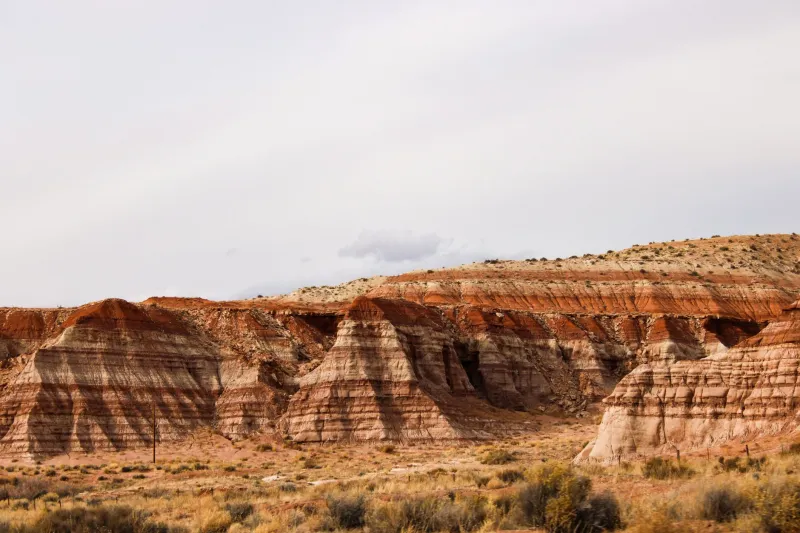
Most people who hike through Grand Staircase-Escalante come for the scenery. The sweeping canyon vistas, the slot canyon light shows, the sheer scale of the place. What fewer realize is that every cliff they're admiring, every ledge they're scrambling over, and every color band painted across the canyon walls is a chapter in a 300-million-year geological story — one you can actually learn to read with a little context.
You don't need a geology degree. You need to know what to look for. Here's a practical starting point.
Why Escalante Is a Geologist's Dream
Grand Staircase-Escalante sits at the intersection of two major geological provinces: the Colorado Plateau and the Basin and Range. What that means on the ground is a landscape that has been lifted, eroded, faulted, and exposed in ways that reveal an almost unbroken rock record stretching back to the late Paleozoic era.
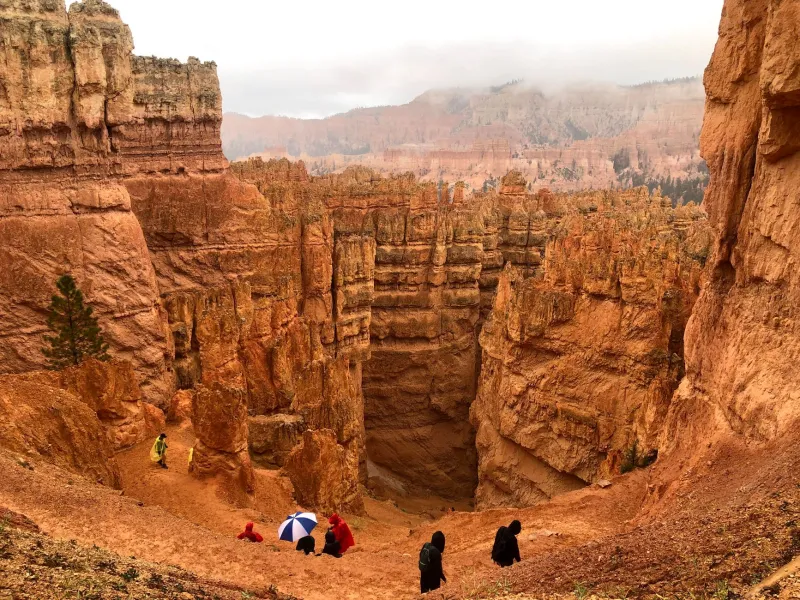
The "Grand Staircase" in the monument's name isn't just a poetic label — it describes an actual geological feature. Moving north to south across the region, you're essentially stepping down through progressively older rock layers, like descending a staircase through time. The Pink Cliffs near Bryce Canyon sit at the top. The Chocolate Cliffs near Kanab represent the bottom step. In between, you pass through the Gray, White, and Vermilion Cliffs — each one a distinct geological layer with its own story.
The Formations You'll Actually See on Trail
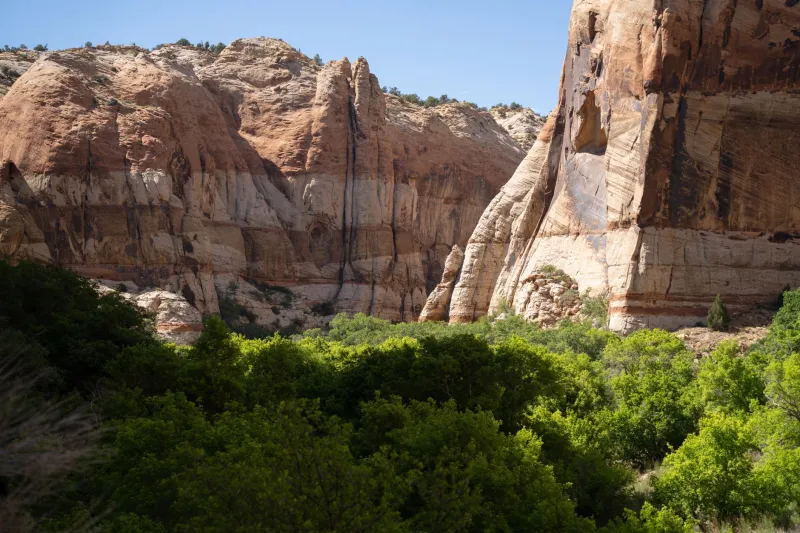
Navajo Sandstone is the rock most people picture when they think of canyon country. It's the creamy white to salmon-pink stone that forms the sweeping, curved walls of slot canyons like Peek-a-Boo and Spooky. Formed roughly 190 million years ago from ancient sand dunes — a Sahara-scale erg that covered much of the American Southwest — Navajo Sandstone preserves the cross-bedding patterns of those original dunes in the diagonal lines you can see running through cliff faces. Look closely at almost any Navajo wall and you'll spot those sweeping curves in the rock: the frozen memory of wind-driven sand.
Entrada Sandstone sits above the Navajo in many parts of the monument and has a slightly redder, more layered appearance. It was deposited in a coastal mudflat and tidal environment, which is why it tends to produce more horizontal banding and erodes into the rounded hoodoos and fins you'll see in certain parts of the backcountry.
Carmel Formation shows up as a pinkish to grayish layered zone between the Navajo and Entrada in many canyon walls. It's a marine deposit — limestone and mudstone laid down when a shallow sea pushed inland across the region. Finding marine rock in the middle of the Utah desert is one of those moments that makes the deep time concept click in a personal way.
Tropic Shale is the soft, dark gray layer that appears in the northern parts of the monument near Cannonville and Henrieville. It was deposited at the bottom of the Cretaceous Interior Seaway — a vast inland ocean that split North America in two around 90 million years ago. The Tropic Shale is famously fossil-rich; it's where paleontologists have pulled significant marine reptile specimens, ammonites, and fish remains. You're not allowed to collect fossils in the monument, but knowing you're walking over the floor of an ancient ocean tends to change how a hike feels.
What the Colors Are Actually Telling You
One of the easiest ways to start reading canyon geology is to pay attention to color, because color in sedimentary rock usually tells you something about the chemistry of the environment in which it was deposited.
Red and orange hues typically indicate iron oxide — essentially rust — which forms in well-oxygenated, often dry or semi-arid environments. Most of the brilliant red rock in Escalante falls into this category.
Gray and green tones often indicate reducing environments — places where oxygen was scarce, like the bottom of a lake, a swamp, or a deep seafloor. When you spot green or gray banding within otherwise red rock, you're often looking at a zone where organic material or groundwater chemistry altered the iron chemistry after the rock was deposited.
White or cream-colored rock, like the upper Navajo Sandstone, often indicates quartz-rich sand that was deposited in a dry, oxidized environment but lacked the iron content to turn red.
Fossils: What to Look For (and What to Leave)
Grand Staircase-Escalante is one of the most significant paleontological sites in North America. The late Cretaceous rock layers here have produced dozens of dinosaur species, including several that were unknown to science before the monument's establishment in 1996. While the major excavation sites are off-limits and actively managed by the Utah Museum of Natural History, casual hikers regularly encounter fossil fragments in eroding rock along trail corridors.
What you might spot: fragments of fossilized bone (usually a dull, slightly rough-textured surface compared to surrounding rock), petrified wood (often with visible grain structure), and invertebrate trace fossils like burrows and tracks pressed into fine-grained sedimentary layers.
The rule is simple and non-negotiable: look, photograph, don't touch or collect. Removing fossils from federal land is illegal, and it also destroys the scientific context that makes a fossil meaningful in the first place.
Making Geology Part of Your Hike
You don't need to memorize formation names to get something out of paying attention to the rock. Start with one question on your next hike: what was this place before it was a canyon? The answer — ancient ocean, desert dune field, river delta, swamp — is usually written in the rock if you know what to look for.
Pick up a copy of the Utah Geological Survey's guide to Grand Staircase-Escalante before your trip. The BLM visitor center in Escalante town also stocks accessible geology resources and can point you toward specific stops where the layering is especially clear and interpretive.
The canyon country of Escalante is beautiful by any measure. But once you start reading the walls, it becomes something else entirely — a record of a world so different from our own that it's almost science fiction, written in stone and waiting at your feet.