Go With the Flow: How to Read the Escalante River Before It Reads You
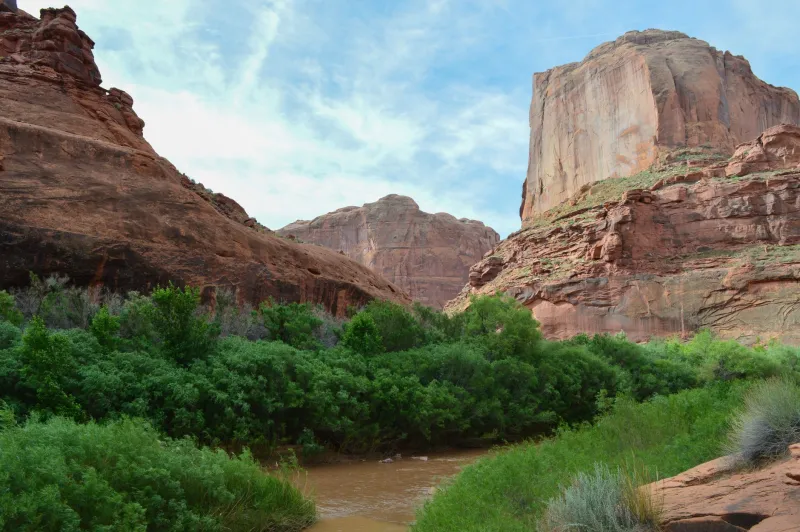
There's a moment most Escalante hikers know well: you're standing at the river's edge, boots in hand, trying to decide whether that murky brown current is ankle-deep or thigh-deep — and whether it matters. The Escalante River doesn't always make that call easy. It can look calm and manageable one hour and turn into a rushing, debris-choked channel the next. Learning to read it isn't just a nice skill to have. It's the difference between a great trip and a genuinely dangerous one.
Why the Escalante River Behaves the Way It Does
The Escalante is a desert river, which means it doesn't follow the rules you might expect from rivers back home. It doesn't have a steady snowmelt source feeding it at a predictable rate. Instead, it responds almost immediately to rainfall — sometimes rainfall that happened miles away in the watershed, well outside your line of sight.
The river drains a massive area of slickrock and canyon terrain. When rain falls on those impermeable surfaces, it has nowhere to go except straight downhill, fast. That's how you get flash floods in clear skies. The storm that triggers a surge might be happening 20 miles upstream while you're standing under blue sky wondering why the water is suddenly the color of chocolate milk.
Seasonal patterns do give you a framework, though. Spring — roughly March through May — brings the highest and most unpredictable flows, fed by snowmelt from the Aquarius Plateau combined with spring thunderstorms. Summer monsoon season (July through September) creates a second window of volatility. Late fall and winter tend to produce lower, more stable flows, which is one reason serious canyon hikers often prefer those months for extended trips.
What the Water Is Telling You
Color is your first clue. Clear or lightly tinted water generally means stable, low-flow conditions. When the river goes orange or deep brown, sediment is being picked up somewhere upstream — that's a sign flow has increased recently or is actively rising. If you see floating debris — sticks, foam lines, uprooted plants — treat that as a red flag and hold your position.
Sound matters too. A low roaring or rumbling from upstream, especially when there's no visible cause, can signal a surge moving toward you. Experienced canyon hikers know to stop and listen before committing to a crossing.
Watch the banks. High-water marks — stained rock walls, debris lines caught in tamarisk branches — tell you how high the river has run recently. If those marks are only a few feet above your current water level and the weather has been active, that's useful context. If you're camped anywhere near those marks, reconsider your site.
Crossing Techniques That Actually Work
Most crossings on the Escalante are manageable with the right approach. The river is rarely more than waist-deep under normal conditions, but even knee-deep fast water can knock you down if you're not ready for it.
Use a trekking pole or sturdy stick on your upstream side — it gives you a third point of contact and lets you feel the bottom before committing your weight. Face slightly upstream and cross at an angle, moving diagonally with the current rather than fighting directly across it. Shuffling sideways is slower, but it keeps you stable.
Unbuckle your hip belt before every crossing. If you go down, a waterlogged pack will drag you under fast. This is non-negotiable, even for crossings that look easy.
For murky water where you can't see the bottom, probe ahead with your pole. Depth can change dramatically within a few feet, and hidden holes or submerged rocks are common. If the current feels too strong to maintain a steady shuffle, move upstream or downstream and look for a wider, shallower section — wider usually means shallower in this terrain.
Finding the Best Crossing Points
The river isn't uniform. It braids, pools, and narrows in patterns that repeat throughout the canyon. Learning to spot good crossing zones will save you a lot of wet gear.
Look for wide, straight sections where the current spreads out and loses speed. Bends concentrate flow on the outside and create cutbanks — those are typically deeper and faster. The inside of a bend, where the water slows and sediment deposits, is often the shallowest crossing point.
Sandbars and gravel bars are your friends. If you see one extending from one bank, there's a good chance the opposite bank has a corresponding shallow zone. Walk the bank and scout both sides before committing.
Avoid crossing near logjams or where large boulders funnel the current. The hydraulics around those features can be surprisingly powerful and create dangerous recirculating currents.
Before You Head Out: Checking Conditions
The USGS maintains a stream gauge on the Escalante River near the town of Escalante. Checking that gauge before your trip gives you real-time flow data in cubic feet per second (CFS). Flows under 20 CFS are generally low and manageable. Flows above 100 CFS warrant serious caution, and anything over 200 CFS should make you reconsider your plans entirely.
The Bureau of Land Management's Escalante Interagency Visitor Center in the town of Escalante is also worth a stop. Rangers there track current conditions and can tell you whether recent weather has affected specific sections of the route you're planning.
Check weather not just at the trailhead but across the entire watershed. Weather apps that show radar for the Aquarius Plateau and the Circle Cliffs area give you a much better picture of what might be heading downstream.
The River as Route-Finder
Beyond safety, understanding the river actually helps you navigate. The Escalante corridor uses the river as its primary trail — you're in and out of the water dozens of times on a typical through-hike. Knowing which side of the canyon tends to have better walking terrain, where the river pinches against sheer walls and forces a wade, and how to read the canyon's width to anticipate upcoming narrows all comes from paying attention to the water and the rock together.
The river wants to show you something on every trip. The trick is knowing how to listen.